In the year 1900, Rodin shows his famous Gate of Hell. He thus reacts with a Prometheus-like humanism to Freud’s discoveries of the unconscious and of the repression of the sexual drive. with this monumental masterpiece, Rodin opens up a new cosmos for art. Its significance to sculpture can be compared to what Van Gogh, Gauguin and Cézanne meant to painting.After centuries of dormant existence, Rodin renews its radiance; he seeks connection with the Italian ‘cinquecento’. Rodin manages to take up the artistic message of the Renaissance, especially that of Michelangelo, and pass it on to future generations. Rodin himself confessed “I go way back, deep into classical antiquity. I want to reconnect the past with the modern age, bring the memory to life, form a judgment about it and finally complement both into a whole. The people are guided by symbols (archetypes, myths, stories PdK). That is very different from lies.” The truth and the greatness of man, that’s what Rodin actually strives for, for that De Helle gate – inspired by Dante’s ‘Inferno’, Ovid’s ‘Metamorphoses’ and Baudelaire’s Fleurs du Mal – forms a reservoir of forms, which only came about from ‘the will to power’ and the power of inspiration, as found in Nietzsche. Rodin is a Michelangelo if he had had the chance to hear Wagner… But he never completed this gateway, he was accused. To which the sculptor seems to have replied: “What about the cathedrals in France, are they completed?” With this irritating Gate of Hell, on which the figures rise and disappear – not so much as loving, but rather as desperate figures – Rodin puts an end in one fell swoop to the stale academicism that has dominated the plastic art for a very long time. There were forerunners like Houdon or Carpeaux who were able to give sculpture an expression of the immaterial and psychological, but Rodin added something entirely new: his ability to convey the tension of passion and confusion of feelings which he experienced himself, to express in his sculpture.
To rewrite your story, you must first identify it. To do that you must answer the question: In which important areas of my life is it clear that I cannot achieve my goals with the story I have got?
Only after confronting and satisfactorily answering this question can you expect to build new reality – based stories that will take you where you want to go.
An artist worthy of the name should express all the truth of nature, not only the exterior truth, but also, and above all, the inner truth. – Auguste Rodin
Your life is the most important story you will ever tell, and you are telling it right now, whether you know it or not. From very early on you are spinning and telling multiple stories about your life, publicly and privately, stories that have a theme, a tone, a premise – whether you know it or not. Some stories are for better, some for worse. No one lacks material. Everyone’s got a story.
There are unknown forces in nature; when we give ourselves wholly to her, without reserve, she lends them to us; she shows us these forms, which our watching eyes do not see, which our intelligence does not understand or suspect. Auguste Rodin
And thank goodness. Because our capacity to tell stories is, I believe just about our profoundest gift. Perhaps the true power of the story metaphor is best captured by this seemingly contradiction: we employ the word ‘story’ to suggest both the wildest of dreams (it is just a story ……) and an unvarnished depiction of reality (okay, what is the story?). How is that for range?
The challenge? Most of us are not writers. That is what I intend to do here in this hero’s journey. First, explore with you how pervasive story is in life, your life, and second, to rewrite it.
“I have always endeavored to express the inner feelings by the mobility of the muscles. – Auguste Rodin
Story is everywhere in life. Perhaps your story is that you are responsible for the happiness and livelihoods of dozens of people around you and you are the unappreciated hero. If you are focused on one subplot – your business – then maybe your story is that you sincerely want to execute the major initiatives in your company, yet you are restricted in some essential way. Maybe your story is that you must keep chasing even though you already seem to have a lot (even too much) because the point is to get more and more of it – money, prestige, power, control, attention. Maybe your story is that you and your children just can’t connect. Or your story might be essentially a rejection of another story – and everything you do is filtered through that rejection.
“Dante is not only a visionary and a writer, he is also a sculptor. His style is lapidary in the good meaning of the word. When he describes a personage he fixes his attitude and his gestures…. I have lived a whole year with Dante living with him and by him, drawing his eight Circles of Hell” – Rodin
Story is everywhere. Your body tells a story. The smile or frown on your face, your shoulders thrust back in confidence or slumped roundly in despair, the liveliness or fatigue in your gait, the sparkle of hope and joy in your eyes or the blank stare, your fitness, the size of your gut, the tone and strength of your physical being, your overall presentation – those are all part of your story, one that’s especially apparant to everyone else. We judge books by their covers not simply because we are wired to judge quickly but because the cover so often provides astonishing accurate clues to what is going on inside. What is your story about your physical self? Does it truly work for you? Can it take you where you want to go in the short term? How about ten years from now? What about thirty?
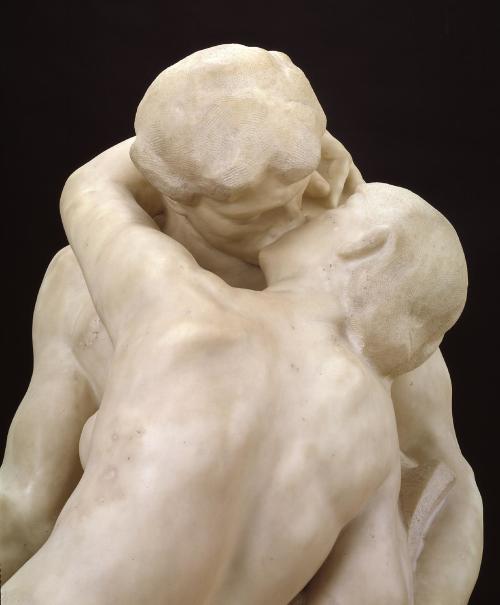
“The man’s head is bent, that of the woman is lifted, and their mouths meet in a kiss that seals the intimate union of their two beings. Through the extraordinary magic of art, this kiss, which is scarcely indicated by the meeting of their lips, is clearly visible, not only in their meditative expressions, but still more in the shiver that runs equally through both bodies, from the nape of the neck to the soles of the feet, in every fiber of the man’s back, as it bends, straightens, grows still, where everything adores—bones, muscles, nerves, flesh—in his leg, which seems to twist slowly, as if moving to brush against his lover’s leg; and in the woman’s feet, which hardly touch the ground, uplifted with her whole being as she is swept away with ardor and grace.”
Rodin revealed human love and life as a process of mutual creation between women and men. Passion is not only a union with those we desire and adore, but also an elevation through shared feelings and sensuality which is always in process, never complete. His representations of the fragility of our mutual creation were as inchoate, vulnerable yet compelling as the material shapes that seemed to emerge only part-finished from the bronze or blocks of stone. Gustave Geffroy
You have a story about your company, though your version may depart wildly from your customer’s or business partners. You have a story about your family. Anthing that consumes our energy can be a story, even if we don’t always call it a story. There is the story of your relationship. The story of you and food, or you and anger, or you and impossible dreams. The story of you, the friend. The story of you, your father’s son or your mother’s daughter. Some of these stories work and some of them fail. According to my experience, an astounding number of these stories, once they are identified are deemed tragic – not by me, mind you but by the people living them.
Like it or not, there will be a story around your death. What will it be? Will you die a senseless death? Perhaps you drank too much and failed to buckle your seat belt and were thrown from your car, or you died from colon cancer because you refused to undergo an embarrassing colonoscopy years before when the disease was treatable. Or after years of bad nutrition, no exercise, and abuse of your body, you suffered a fatal heart attack at age fifty – nine. ‘Senseless death’ means that it did not have to happen when it happened; it means your story did not have to end the way it ended. Think about the effect the story of your senseless death might have on your family, on those you care about who you are leaving behind. How would that story impact their life stories? Ask yourself, Am I okay dying a senseless death? Your immediate reaction is almost certainly, “No!, of course not!

In 1880, a petition from artists to the Ministry of Art and Culture led to “Monsieur Rodin, a sculptor, being commissioned, for a sum of 8,000 francs, to design a carved door in bas-relief for the Musée des Arts Décoratifs and should have Dante’s Divina Commedia as its theme”. In addition, the state makes a large studio available to him. Rodin immediately set to work, re-reading the Divina Commedia, filling hundreds of pages of his sketchbook, making dozens of models and tirelessly studying similar works: the doors of the Baptistry of Florence and, in particular, Ghiberti’s door, the so-called “Paradise Door”. ‘. Rodin said, “Dante is not only a seer and a writer, but also a sculptor.” Paolo and Francesca, Ugolino and various damned should be considered direct interpretations of Dante’s work. The thinker is an image of the poet himself. But soon Rodin expands the theme and adds characters who betray Baudelaire’s influence. His explicit intention is to create a universe, to realize a fresco of passions and human feelings. This gigantic task is the reservoir of forms from which Rodin will draw again and again to create with his own hands a whole series of groups of figures, all ‘individualised’; each group is a masterpiece that can claim autonomy.
Unhealthy storytelling is characterized by a diet of faulty thinking and, ultimately, long – term negative consequences. This undetectable, yet inexorable progression is not unlike what happens to coronary arteries from a high-fat, high-cholesterol diet. In the body, the consequence of such a diet is hardening of the arteries. In the mind, the consequence of bad storytelling is hardening of the categories, narrowing of the possibilities, calcification of perception. Both roads lead to tragedy, often quietly.
The cumulative effect of our damaging stories will have tragic consequences on our health, engagement, performance and happiness. Because we can’t confirm the damage our defective storytelling is wreaking, we disregard it, or veto our gut reactions to make a change. Then one day we awaken to the reality that we have become cynical, negative, angry. That is now who we are. Though we never quite saw it coming, that is now our true story.
We enjoy the privilege of being the hero, the final author of the story we write with our life, yet we possess a marvelous capacity to give ourselves only a supporting role in the ‘storytelling’ process, while ascribing the premier, dominant role to the markets, our family, our kids, fate, chance, genetics. Getting our stories straight in life does not happen without our understanding that the most precious resource that we human beings possess is our energy.
It is our storytelling that drives the way we gather and spend our energy. Stories determine our personal and professional destinies. And the most important story you will ever tell about yourself is the story you tell to yourself.
So, you would better examine your story, especially this one that is supposedly the most familiar of all. Participate in your story rather than observing it from afar, make sure it is a story that compels you. Tell yourself the right story – the rightness of which only you can really determine, only you can really feel – and the dynamics of your energy change. If you are finally living the story you want, then it need not – it should not and won’t – be an ordinary one. It can and will be extraordinary. After all you are not just the author of your story but also its main character the hero. Heroes are never ordinary.
In the end your story is not a tragedy. Nor is it a comedy or a romance or a thriller or a drama. It is something else. What label would you give the story of your life, the most important story you will ever tell. To me that sounds like a hero’s journey.
End of story.
 The Hero's Journey